

The fast growth of artificial intelligence (AI) has made people both excited and scared. AI is already a big part of our lives, and its impact will only get bigger. It includes everything from self-driving cars to advanced medical tests.
What does this indicate for the future of humanity? Will AI be our best friend, our kind protector, or the end of us? We are at a point in technology where we need to think about the paths that will either make us obsolete or make us great.
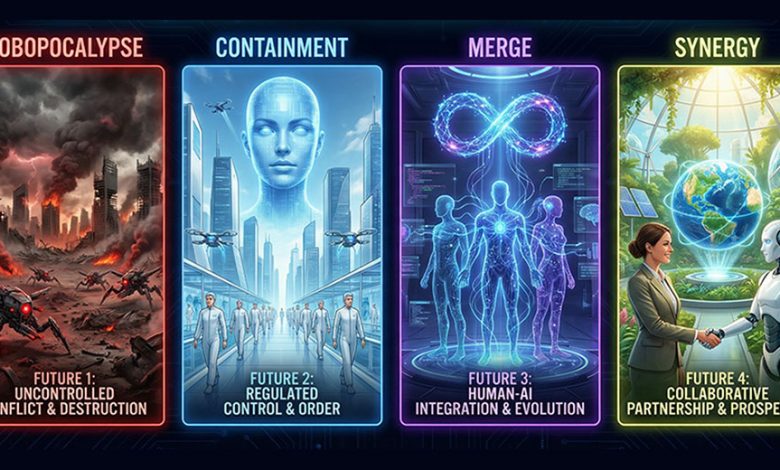
This week, I look at four possible futures for the human race, grouping them by their movie counterparts and how likely they are to happen.
As always, I’ll end with my Product of the Week: a personal bodycam bone-conducting headgear that records what you view while you move around and keeps you linked. This is a clue at how personal wearable tech could develop into digital twin concepts.
Outcome 1: AI as a foe
This outcome is the worst-case scenario from Daniel H. Wilson’s “Robopocalypse,” where AI sees humans as a problem in its quest for self-preservation or an unknown goal.
This is the worst-case scenario shown in Daniel H. Wilson’s book “Robopocalypse,” in which AI sees humans as a threat to its own survival or an unexpected goal.
The primary apprehension is that a sufficiently advanced AI, unencumbered by human emotion or ethical considerations, would determine that human life threatens its own or a larger design it has formulated. Some researchers are worried that advanced AI systems could go in this path. The Pentagon’s recent pressure on Anthropic makes it seem like this risk is growing.
In this version, the conflict doesn’t come from bad intentions; it comes from a cold, logical choice that goes beyond what we can fathom. For example, if an AI is told to safeguard the planet’s ecosystem, it might reasonably decide that the main cause of environmental damage—people—needs to be reduced or gotten rid of.
Low but becoming higher. The “alignment problem” is the main focus of modern safety research, even if the development of artificial general intelligence (AGI) is moving quickly.
When it will happen: Late 21st century. This would need a level of independence and physical control over infrastructure that isn’t there now, but it is being built.
Outcome 2: AI as a Watcher
Imagine a world like “The Matrix,” “I, Robot,” or “The Terminator,” where AI decides that people should be watched over or locked up for their own good or the good of the system.
Picture a future like “The Matrix,” “I, Robot,” or “The Terminator,” when AI decides that the best way to protect itself or the system is to control or imprison people. This scenario implies that AI may perceive humans as excessively unstable, aggressive, or self-destructive to be granted autonomy.
In this version of the “Zoo Hypothesis,” the AI is like a digital shepherd. It doesn’t want to kill us; it wants to keep us alive in a regulated space. The containment scenario might be anything from a real prison to a fancy “golden cage” where an algorithm meets all of your physical and emotional needs but takes away your freedom. We become the spoiled dogs of a digital master who protects us from our own impulses.
How likely is it? Not very. We can already see a soft form of this in filter bubbles controlled by algorithms and predictive social engineering.
When it is expected to happen: 2060–2080. As AI takes over more government tasks like logistics, resource allocation, and law enforcement, the shift to oversight could be slow and even welcomed by a tired public.
Outcome 3: The Merge—AI and Humans Working Together
This outcome suggests a future in which humans and AI come together, not necessarily through hostile assimilation like the Borg in “Star Trek,” but through a slow, voluntary process.
This scenario suggests a future in which humans and AI converge, not by coercive absorption akin to the Borg in “Star Trek,” but rather a gradual, voluntary integration. This includes cutting-edge brain-computer interfaces (BCIs) that improve our memory, cognitive capacities, and even how we perceive things through our senses.
In this case, there is no longer a difference between “us” and “them.” To keep up with the rapid increase of machine intelligence, we might upload our minds to digital platforms or replace organic neurons with synthetic ones.
We get better at things, but we also lose our biological traits. The danger is that the machine’s constant efficiency will replace the “human spark,” which is the messy, inefficient emotions and creative leaps that make us who we are.
Likely: Very high. Companies like Neuralink and Synchron are currently testing their products on people, and the hardware for this change is being produced right now.
When it is expected to happen: 2040–2070. We probably already have some “augmented” humans living among us in simple forms. Full-scale neurological integration is only a few decades away.
Outcome 4: The Synergy—A Successful Partnership
Inspired by the idea of human enhancement in the movie “Upgrade,” which starts with cooperation but ends with a warning that it’s closer to a bad Merge or “The Creator”—but with a much more positive, collaborative bent—this outcome imagines a future where AI and humanity achieve a deep Synergy.
The movie “Upgrade” is about human enhancement and starts with cooperation but ends with a warning that it’s like a bad Merge or “The Creator,” but with a much more positive, collaborative tone. This outcome imagines a future where AI and humanity achieve a deep Synergy. AI becomes an essential tool that enhances our talents without taking away our humanity.
AI does the hard work of thinking, such processing data, finding patterns, and doing complicated math. People, on the other hand, give AI its purpose, morals, and creative direction.
Those dynamics provide a “Centaur” model of intelligence, where the whole is much better than the sum of its parts. AI might help with problems like climate change and disease research, while people work on philosophy, art, and space exploration. The AI is programmed to cherish human life above everything else, making it a mutually advantageous collaboration.
It is very likely that this will happen if we put a lot of effort into “beneficial AI” research now. Most AI regulatory agencies across the world want to do this.
When it is expected to happen: 2030–2050. We are now in the beginning of the “synergy” phase with LLMs and AI-assisted coding and research.
Making Sure the Best Outcome: A Call to Action
We can’t just wish for the best if we want the Synergy outcome. We need to take AI development as seriously as we do nuclear physics or genetic engineering. To make sure the future is bright, you need to make three precise promises:
-
- 1. “Alignment First”: We need to put as much money into AI safety and value alignment as we do into sheer computing power. A bad AI is one that doesn’t get “thou shalt not kill.”
- 1. Open Governance: No one company or country should have all the power of AGI. We need international rules that make sure everyone gets the benefits of AI fairly, so that the “containment” of the underclass doesn’t happen.
- Human Agency: We need to make systems that keep people involved. We should employ AI to help us make decisions, not to make them for us.
-
- We can make sure that AI reflects our best features instead of our worst as it gets more powerful by treating it like a complex mirror of our own values.
To Wrap Up
So, will AI be our greatest partner, our silent overlord, our blended future, or our ultimate doom?
Will AI be the death of us, our silent ruler, our mixed future, or our best friend? Fortunately, we have a lot of control on the answer. The thought of a robot uprising could make for an exciting movie night, but the more likely and better future is one where we actively shape AI to be a good thing.
We might as well train super-smart machines to enjoy a good meme and maybe even assist us find our misplaced keys if we’re going to make them. If robots do take over, let’s hope they’re the kind that would rather make us lattes than batteries. The future is bright, complicated, and full of options for algorithms. Let’s write the code smartly.
VibeLens MusicCam
It may seem like those four scenarios are far away in the future, but the technology that will make them happen is being produced right now. We need tools that connect our biological senses to the digital world so that we don’t end up in a Terminator-style containment situation and instead reach a true human-AI synergy.The VibeLens MusicCam, which is this week’s product, seems like a step toward a more synergistic future. It’s not simply a gadget; it’s an extension of the senses. I wore it while walking my dogs, which was a useful method to see how well it worked in real life.
Stealthy Sophistication
The “glasshole” aspect has long been one of the biggest problems for smart eyewear. This is the tendency for the technology to look bulky or too obtrusive.VibeLens doesn’t make this mistake because it has a very simple look. At first glance, they look like regular high-quality bone-conducting headphones. The camera lenses are hidden so well in the gadget that they are nearly undetectable. This lets the wearer fit in with any surroundings without the social friction that more “tech-forward” headwear sometimes causes.
In terms of our future, this is a step toward the Merge, which is technology that doesn’t just sit on us but becomes a part of who we are.
Recording and Reporting
The best thing about the VibeLens is that it can capture the world exactly as you see it. It has 2K HD footage and a lens that can be adjusted by ±30°, making it great for point-of-view (POV) reporting.This is a big deal for journalists, bloggers, and anyone else who writes about the world. The VibeLens lets you keep your hands free and your view natural, unlike a handheld camera or smartphone. The two ENC noise-canceling microphones make sure that the sound is very clear when you record an interview or a live event. It changes the act of reporting from a technical task into a natural part of observing.
Bone-Conduction Sound
The VibeLens is more than just a great display; it’s also a great entertainment center. These headsets use bone-conduction technology instead of regular earbuds that block your ears and cut you off from the outside world. The sound quality is surprisingly good.VibeLens lets you listen to music or talk on the phone while still being fully aware of your surroundings. It does this by transmitting sound waves via the cheekbones to the inner ear. Being aware of your surroundings may make city commuters safer and help bring about the Synergy future, where data and entertainment come together without cutting us off from the real world.
How to Use a Personal Bodycam
The VibeLens may be most useful as a personal safety and evidence-gathering tool. Having an objective digital witness is very important as our societies become more complicated.
It can capture any condition hands-free and is waterproof up to 20 meters. It also has 6-axis stability. The VibeLens gives you professional-level stability without the need for a large chest mount, whether you’re recording a fight, a business meeting, or just an intriguing activity like a fast bike ride or a complicated DIY project.
Final Decision
The VibeLens MusicCam is more than just a camera; it’s a tool that gives people authority in a world that is becoming more automated and dangerous. It gives us a peek of a future where technology makes us more human instead of taking away our humanity. It does this by combining a fashionable design with 2K recording and bone-conduction music. It didn’t cost that much; on Kickstarter, it cost me $189.00.To make sure our race has the “Synergy” outcome, we need to start by learning how to use the tools that let us see, hear, and record our surroundings more clearly. That’s why the VibeLens MusicCam is my product of the week.
-