

Adobe Summit 2026 made it plain that Adobe does not want to be viewed as anxiously introducing AI to older products. It wants to create the way that customer service and marketing work in the agentic era.
That’s a big swing.
To Adobe’s credit, the event didn’t feel like a hazy AI pep rally. The organization arrived to Las Vegas with a better story, a better understanding of how creative and marketing are connected, and a better idea of where enterprise expenditures are going next.
Adobe called the headline “Adobe CX Enterprise,” and it was about an end-to-end, agent-based AI system for managing the customer lifecycle from acquisition to loyalty. That positioning is important since Adobe isn’t just talking about tools anymore. It talks about systems, governance, orchestration, and how businesses do.
Big Bet on Orchestrating Customer Experience
It was evident that the main topic of the event was customer experience orchestration. Anil Chakravarthy, the president of Adobe’s Customer Experience Orchestration, remarked, “Customer experience orchestration is here now in the age of AI.” Adobe thinks that AI will not only speed up activities, but also revolutionize how brands plan, produce, deliver, personalize, and measure across numerous channels.
This frame is brilliant. It takes the conversation away from comparing different image models. Adobe would rather compete on workflow gravity, enterprise context, and execution across the stack. This is a stronger stance overall.
Adobe Wants to Connect AI, Marketing, and Creativity
The second element is that Adobe wants to combine creative and marketing into one system. These worlds have talked to each other, but not very often cooperated together. The business tried to get rid of that line with Summit 2026. Shantanu Narayen, the CEO of Adobe, remarked that there needs to be “a way to bring together creativity, marketing, and AI across the entire content lifecycle, from idea generation to creation to personalization, orchestration, and measurement.”
That’s not just a product plan; it’s the main point of the event. You may also see that in the Firefly news.
Adobe called Firefly a “AI-first creative studio” when it showed off a new Firefly AI helper that enables creators control complicated multi-step workflows through an interactive interface. The goal wasn’t only to make images faster; it was to bring the gap between intention and execution closer together while still letting creators stay in charge.
David Wadhwani, the president of Adobe, dubbed this “a new era of agentic creativity.” This is important because Adobe wants people to see AI as more of a smart production partner than a slot machine.
Brand governance is more important now that we have agentic AI.
That brings us to the third main point, which is one of the more believable ones. Adobe recognizes that speed isn’t everything. Narayen added, “It’s not enough to just make the most content to win.” It’s really about making the perfect content that fits the brand and is big enough. That is the best point to make in this market. There is no shortage of content in the AI age. It’s making quality control a nightmare.
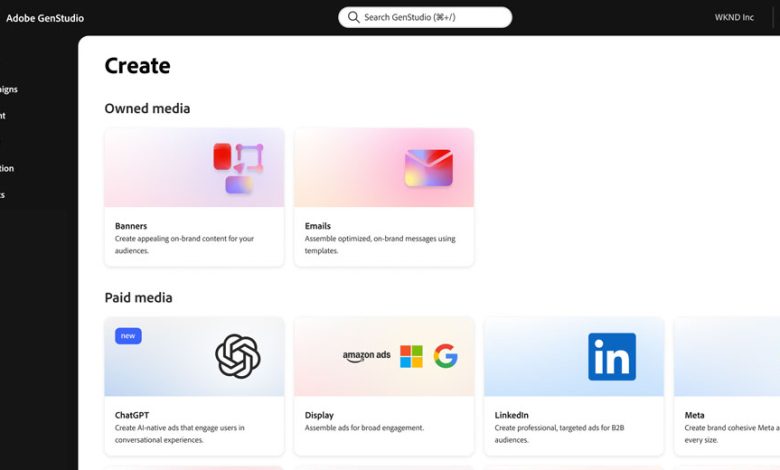
Adobe’s response is the expanded GenStudio content supply chain story and Brand Intelligence.
Brand Intelligence is meant to help businesses move beyond static brand books and into a system that learns from approvals, rejections, notes, and comments from the review cycle. In simple terms, Adobe aims to make brand governance more useful by changing it from a PDF that no one reads into something that machines can read. That’s one of the more useful ideas that came out of Summit. Enterprise AI doesn’t work well when a brand team has to fix every output by hand.
Varun Parmar, the GM of Adobe GenStudio and Firefly for Enterprise, made the point obvious. He said that the campaign process has long been “hampered by inefficient processes and broken workflows,” and Adobe is seeking to address that by bringing together “brand intelligence, agentic automation, and AI-powered workflows.”
That sounds like typical business message, but this time it really hits home. Most marketing companies don’t have a problem with AI. They think they have an AI problem, but they really have a process problem.
Trust is another facet of this concept. Adobe kept talking about governance, accountability, context, and business safety. That wasn’t an accident. In a business setting, the fastest model doesn’t always win. There is a good chance that the model or procedure that stops the legal, brand, and compliance teams from falling apart will work.
Open Ecosystems, Real Workflows, and the Need to Show It
Another focus was openness and practicality in ecosystems. Adobe doesn’t think it would win by making users use a closed system; instead, the business underlined that its products should work with other products.
Adobe CX Enterprise works in both Adobe and partner environments. It has more partnerships with AWS, Anthropic, Google Cloud, IBM, Microsoft, Nvidia, OpenAI, major agencies, and systems integrators.
Amit Ahuja, Adobe’s VP of Ecosystem Development, argued that marketers shouldn’t have to pick between AI tools for businesses and marketing results. Adobe wants to fill that gap with connectors and the ability to add to workflows.
Adobe appeared more disciplined than defensive here. The market is different now. There is no way that one model, agent framework, workflow tool, or data environment will work for a big business. It looks like Adobe knows that the real reward is to be the layer that gives those moving elements a business context, rules, and measurable results.
When Nvidia CEO Jensen Huang declared, “The user interface of the future, all the front end of SaaS, is now agentic,” he added to that point of view from a different aspect. That comment worked because it backs up Adobe’s bigger point that the interface is changing, but the business still requires reliable infrastructure underneath it.
AI Discovery Changes How Brands Are Seen
Another crucial point was the rise of AI-mediated discovery and the increasing importance of brand awareness in LLM-driven environments. This might have been one of the most interesting parts of the lecture since it goes beyond internal efficiency to look at market risk.
Chakravarthy noted that LLMs and AI platforms are becoming the main way that customers and companies interact. He pointed to Adobe’s research indicating that AI-driven traffic to U.S. web sites climbed 269% year over year in March.
He went on to say that 80% of firms have big problems with how their brands show up on AI platforms. That is a very serious warning. Paid media will change along with search and discovery.
Adobe’s answer includes Brand Concierge, modifications to the supply chain for conversational surfaces, and help for ChatGPT Ads in GenStudio for Performance Marketing. Adobe isn’t simply keeping an eye on new interfaces; it’s also aggressively combining the ad and content stack.
Enterprise Reality Slows AI Goals
There was also a stream of caution in the business world at the Summit, which was a good balance. Adobe’s own AI and Digital Trends report took away any sense of victory. It discovered that many companies still don’t have the tools they need to expand agentic AI, even though they are already witnessing some early successes with generative AI.
Data is still broken up. The alignment isn’t even. Deployment across the entire company is still uncommon. Less than half of companies feel their data is good enough for AI, and only 39% have a shared consumer data platform that can handle agentic AI. That is the annoying truth underlying all the keynote buzz.
Customers are just as unforgiving. Adobe’s survey states that half of customers only give promotional content two to five seconds, and half of them stop paying attention if the promotions aren’t relevant or come at the wrong time. AI can make personalization bigger. But bad data and broken workflows make AI fail faster.
Difference Between Vision and Action
That tension could be the most important thing to remember from Adobe Summit 2026. Adobe’s ambition is big and, in many ways, very interesting. The business is making a strong effort to own the link between creative generation, brand governance, data-driven decision-making, and agentic execution. It also makes the appropriate business case that trust, governance, and interoperability are just as important as model horsepower.
Narayen added, “Tools don’t create, people do,” and that sentence did a great job of retaining Adobe’s focus on people even as the company moves more toward automation.
Let’s not fool ourselves, though. Adobe is trying to achieve this at a time when investors, customers, and competitors are all asking harder questions. The corporation needs to show that its AI agents can help it remain ahead of AI-native disruption. It’s okay to be skeptical. Adobe’s plan is more consistent than ever, but being consistent doesn’t mean people will use it. Companies still need to put all of this into action.
In the end, Adobe Summit 2026 wasn’t about flashy AI tricks. It was about Adobe setting the rules for how businesses will use digital experiences in the future. The startup predicts that the victors won’t be the ones with the loudest demo, but the ones that can make creativity, data, governance, and agentic processes into something that can be used by a lot of people.
That is the right bet. Adobe now has to show that it can deliver on it.