
The cloud has been the main place for computation and data in the tech industry for a long time. Last week at HP Imagine 2026 in New York, HP presented a strong argument for moving more of that intelligence to the edge. They focused on AI workloads operating on devices and enterprise workstations.
This change is part of a bigger change in business AI. Companies are starting to put AI directly into workflows and gadgets instead of trying out separate technologies. HP’s goal is for AI to be a part of everyday computing, functioning locally instead than as a remote service accessed through the cloud.
Let’s take a look at what HP showed off at Imagine 2026 and what it means for business computing. The HP EliteBook 6 G2q is my Product of the Week. It shows how the business is marketing their next-generation AI PCs.
Change in Leadership and Execution
Before we get into the hardware, it’s important to talk about how HP has changed internally. When there are changes in leadership, like a new CEO and a simpler structure, people often wonder how things will get done. HP didn’t directly address those issues during Imagine 2026; instead, they concentrated on displaying progress.
HP is focusing more on domain-specific use cases than competitors like Dell and Lenovo, who are still pushing general-purpose AI PCs. The company says that AI models will be more and more customized for certain industries and workflows, and it is structuring its portfolio to reflect this.
HP is also seeking to keep its reputation for dependability while working on new projects like Google Beam and edge-based AI systems. That way of doing things shows that the company is trying to update its portfolio while still meeting the security and compliance criteria that business clients need.
The Economics of Edge AI
One of the most important topics at the presentation was what HP called the “AI tax,” which is the rising expense of operating AI workloads in the cloud. The company said that this was a scaling problem, where the expenses of infrastructure and API usage might go up quickly as more people use AI technologies.
HP’s answer is to do more inference on local devices. The company says that businesses can save both latency and recurring expenses by running models on workstations and PCs instead of relying just on the cloud.
The corporation is supporting that plan with more powerful gear. HP referred to devices like the ZBook Fury, which has a lot more AI processing power, and said that on-device performance will keep getting better over the next few years. It also showed big language models operating on a workstation, which showed how much they want to keep data and processing on the device.
This method also fits with the growing interest in “sovereign AI,” which is when companies maintain sensitive data and AI processing on their own servers instead of using cloud services from other companies.
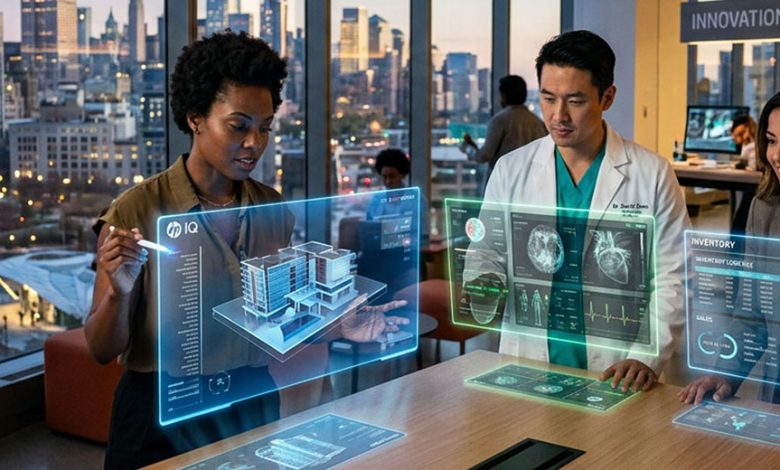
Connecting AEC Workflows from Start to Finish One of the more developed areas that HP worked on was its end-to-end ecosystem for Architecture, Engineering, and Construction (AEC) professionals. HP described a process that would link design, simulation, and work done on site:
- Model/Simulate: Teams can use HP Workspace to upload changes and see how they look in different design versions.architecture: The Z6i Fury AI workstation has a modular architecture that lets you upgrade the hardware and add more powerful GPUs in the future.
- Physical Execution: Designs can be output using DesignJet printers and extended to instruments like the SitePrint robot, which translates plans directly onto construction surfaces.
The method shows HP’s endeavor to bring together hardware, software, and output devices into a more streamlined process. HP is constructing a larger, more integrated stack for AEC environments, while competitors tend to focus on certain elements of that process.
3D Collaboration Without Headsets Google Beam was a big statement about collaboration at the event, and it’s now part of HP’s growing portfolio. This method lets people talk to each other in 3D without having to use VR headsets or AR glasses.
HP Dimension with Google Beam, which is slated to come out in late 2026, seeks to make 3D communication more immersive. The technology is meant to let people feel more present without using headsets, making it a good alternative to standard video conferencing and more complicated AR/VR installations.
If it works, this method could be attractive to companies that want more immersive communication without the cost and hassle of headset-based systems.
HP is using edge AI in certain industries, such as retail, healthcare, and travel.
- Retail: Systems can recognize consumers who come back and give workers real-time information to help them give more personalized service.1. “Clinical: Local inferencing can help with treatment recommendations and give patients more personalized insights.”
- Travel: Partnerships aiming at improving real-time routing and identification could assist speed airport security and passenger flow – something many of us could have used recently.
These examples show a bigger change from features that work on their own to business outcomes that can be measured. HP also thinks that over time, a bigger part of AI inference will move to the edge. The startup is trying to have a bigger impact on that ecosystem by bringing together hardware, software, and services.
HP IQ and AI on Devices
HP IQ shows that HP is moving toward a more local-first AI strategy, even though much of the industry still uses cloud-based assistants.
HP IQ is based on a huge local model that runs directly on the device. Imran Chaudhri, a former Apple and Humane designer, lead a team that worked on it. It doesn’t work as a separate app; instead, it works with the whole system to offer features like natural language assistance and automatic meeting notes.
HP IQ also works with HP NearSense, which lets devices that are close to each other find and talk to each other. This makes it easier for people to move files, datasets, or presentations between devices in shared spaces.
HP IQ helps protect sensitive data on local systems by focusing on processing on devices instead of on the cloud.
Enterprise Hardware and Security HP made changes to all of its enterprise hardware. The EliteBook 6 G2q is the best AI PC on the market right now. It has more processing power and a longer battery life. The business also mentioned possible benefits of employing local AI for things like reviewing contracts.
Another area of focus was security. For example, HP TPM Guard was included to make protections between hardware components stronger and protect against more advanced physical and side-channel assaults. HP has made changes to all of its printers, adding capabilities to help with long-term data protection and encryption issues.
HP has kept growing its gaming business under the HyperX name. The company is trying to reach a wider prosumer audience by moving more of its peripheral focus from Omen to HyperX.
There is some overlap between high-performance workstations and gaming peripherals, especially when it comes to how precise and responsive they are to input. HP seems to be putting these product groups together to appeal to people who care about performance in both professional and personal use.
Wrapping Up: HP’s Plans for Edge AI
HP Imagine 2026 showed how the company has grown beyond only PCs and printers to include a wider range of platforms and AI-powered features.
The plan is to make AI more immediately available on devices, rely less on cloud infrastructure, and improve collaborative tools, all while keeping a strong focus on security and data protection.
HP is focusing on execution and alignment around its edge AI strategy, even though there have been recent changes in leadership. This will help businesses deploy AI more widely in their processes and environments.
We often talk about “inflection points” in the tech world. These are times when hardware and software make big changes to how we work, not just speed things up.
In the computer world, we often talk about “inflection points,” which are times when technology and software impact the way we operate in a big way, not just make things run faster. The HP EliteBook 6 G2q might be one of the first examples of this change.
Many early AI PCs have delivered small updates, but the EliteBook 6 G2q is different since it focuses on how well AI works on the device itself. Built on the Snapdragon X Elite platform, it can process up to 85 TOPS of NPU, which is a big improvement over first-generation systems and is enough to handle more complicated local AI tasks.
Battery life and mobility are still quite important for people who work on the go. The system has a battery life of up to 28 hours and is thinner and lighter, making it great for long periods of use away from a desk.
That being said, there is still room to try out new designs. HP’s old Folio form factor had a unique take on ergonomics, and combining that with modern AI performance might lead to some interesting new ideas.
The 6 G2q is also noteworthy since it is the base for HP IQ, the company’s new AI software layer. To run these features locally, the device needs to perform better, and systems like these are made to enable that change. If HP IQ takes off, hardware like the 6 G2q might be a big part of that plan.
In July, you should be able to buy the HP EliteBook 6 G2q on HP.com. Closer to when the product is available, prices will be given.
The EliteBook 6 G2q is the best laptop out there right now for mobile professionals who need to stay connected (the 5G carrier switching is a great touch) and want to be at the forefront of the AI revolution instead of just reading about it.