
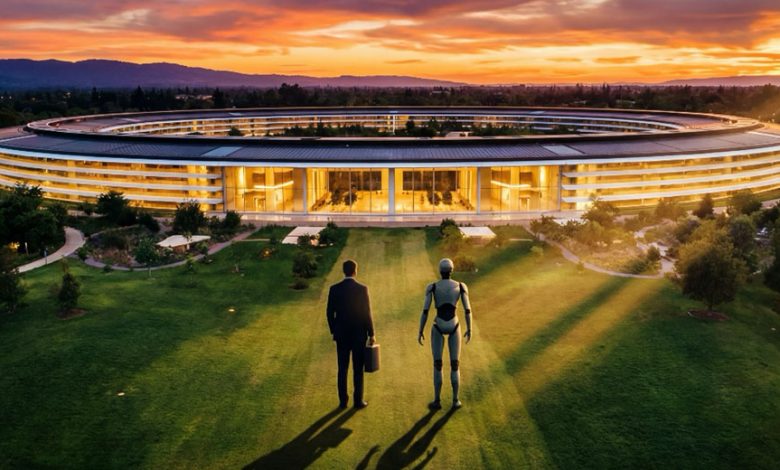
Last week, Apple announced that John Ternus would take over as CEO from Tim Cook, who will become executive chairman. This decision feels both necessary and very careful.
Ternus has been the face of Apple’s hardware engineering for years, making sure that the iPhone and Mac stayed the best examples of industrial design. He is getting a copilot, not the keys to the kingdom, as he takes over the top slot.
Cook’s elevation to executive chairman is a common business move that is typically meant to keep things going. But in the fast-paced world of technology, staying the same is often the enemy of change.
Cook is still an employee with operational influence because he is still an executive instead of a traditional non-executive chairman. His continued presence as executive chairman creates a dual-headed dynamic at the top of Apple, where the new CEO may need to constantly look over his shoulder at the architect of the last decade’s successes.
This week, I’ll look at Apple’s change in leadership and whether Cook’s ascension to executive chairman helps or hurts innovation. As always, I’ll end with my product of the week: the 1X New Humanoid Home Robot, which is the most Apple-like personal robot thus yet.
Governance Risks for the Executive Chairman
The post of executive chairman is well-known for being difficult from a corporate governance point of view. Good governance usually means that the Board of Directors, which is in charge of the firm, and the CEO, who administers it, should be separate from each other. When the old CEO becomes the executive chairman, that border is so blurred that no one can see it.
This structure typically causes “shadow CEO syndrome.” Does Ternus really have the power to change Apple’s direction toward a risky, high-reward AI project that goes against Cook’s long-standing “supply chain first” philosophy?
Recent trends in corporate governance demonstrate that boards are being pushed harder to get more involved in strategy. But an executive chairman can unintentionally stop the very upheaval that a firm needs to stay in business.
There have been many times in history when an exiting CEO lingered too close, making it harder for the new CEO to make required adjustments that were frequently painful.
Apple is known for its “single throat to choke” concept of accountability, so this loss of leadership could lead to stagnation.
AI, Robotics, and the Iteration Trap
In the age of agentic AI and autonomous systems, it seems like Apple is more interested in protecting its history than in coming up with new ideas for the future. Apple got quite good at “fast follow” and “perfected iteration” under Cook. It didn’t come up with the smartphone or the tablet, but it turned them into ecosystems worth trillions of dollars.
Devices are moving away from being focused on hardware and toward experiences that are focused on AI. Apple seems to be a firm that doesn’t like taking risks, as shown by its failed “Project Titan” car. Competitors like Nvidia, Tesla, and even Microsoft are making big bets on self-driving cars and humanoid robots.
Apple’s present plan is quite cautious. Instead of coming up with a new idea for what a future without smartphones would be like, the business is focusing on Apple Intelligence as a feature of the iPhone. Apple is putting more money into the pocket screen at a time when ambient companion sensors and autonomous agents could soon make the screen in your pocket less important.
Ternus is a hardware guy through and through, therefore he’s the right fit for a company that wants to keep manufacturing the best metal rectangles in the world. But is he the best candidate for a world that may not want rectangles anymore?
Two Ways for the House of Jobs
Apple is at a point that will shape its next fifty years. Ternus can go along one of two different paths:
Path A: The Living Fossil.In this case, Apple still sees the iPhone as the center of all its other goods. The business is mostly working on small changes, like narrower bezels, quicker CPUs, and “AI features” that are really just better Siri capabilities.
Apple might become the king of a tiny hill as the world goes toward wearables and ambient computing. It may become a legacy premium brand, like IBM in the 1990s or BlackBerry in the 2010s. It would be very profitable in the short term, but less and less important to the cutting edge of human-tech interaction.
Path B: The Radical Rebirth.Ternus has to do the inconceivable to follow this path: eat the iPhone. Ternus has to change Apple’s focus to “personal robotics and intelligence” in the same way that Steve Jobs released the iPhone while the iPod was still a cash cow.
This change would take Apple away from the App Store model and into an agent-driven approach, where the corporation runs self-driving algorithms that take care of daily activities. It would also need a big push into robotics, not as a side project but as the main way people interact with their homes and offices.
Laurels or Reinvention?
Apple needs to quit living off the success of the 2010s if it wants to stay relevant. The “Apple tax” and ecosystem lock-in are strong tools, but they won’t stop the big change toward AI-first hardware. Apple’s great supply chain won’t be enough to save it if a new company or a revived competition comes out with a wearable or robotic interface that makes the smartphone feel as clumsy as a rotary phone.
Ternus needs to show that he is not only Cook’s assistant. He needs to support a moonshot that doesn’t just bring AI to a Mac, but also uses AI to change what a Mac is. Someone else will probably lead the way into the post-smartphone age if Apple doesn’t. This person will probably be more willing to fail.
To Wrap Up
The choice of John Ternus as CEO is a sign of stability, but Tim Cook’s rise to executive chairman could mean a more cautious future. Apple is at its best when it shakes things up, not when it keeps its profits safe.
The Ternus-Cook team is a safe place for investors right now, but it could keep the company stuck in a hardware-focused past in an AI-focused future. Apple needs to chose the danger of the unknown over the comfort of the iterative if it wants to be the most valuable company in the world again.
The 1X NEO Home Robot The humanoid home robot is folding clothes in a modern living room while a person stands nearby.
The NEO Home Robot by 1X could be the most believable “iPhone moment” in the new field of personal robots.
Even while big tech companies keep making small changes to glass rectangles, like Apple’s safe but small MacBook Neo entry-level line, 1X, with help from OpenAI, has made a general-purpose humanoid robot just for the house.
The NEO takes autonomous physical help into the living room, just like the first iPhone took professional-grade computing from the server room to the pocket. It is the opposite of present big-tech conservatism since it creates a new category of product instead of preserving an old one.
The NEO is a big step forward for embodied AI because it is silent, light (just 30 kg), and safe for people to use. NEO doesn’t focus on heavy-duty torque and factory application like industrial competitors like Tesla’s Optimus. Instead, it uses a tendon-drive technology that mimics organic muscles. Because of this architecture, it can interact with its surroundings in a gentle way, doing things like folding laundry and greeting guests.
The NEO sets a new standard for meaningful disruption for people who are keeping an eye on the innovation landscape in 2026. It shows a bigger change: the next ten years won’t be won by people who make the best screens, but by people who make the best and most user-friendly autonomous agents.
Key Innovations
Soft Actuation and Safety: NEO runs at just 22dB and is practically pinch-proof because it uses low-inertia, electrically driven “myofibers.” It is one of the first humanoids made for child-safe situations since its soft body and special lattice polymer structure make sure that even inadvertent bumps don’t hurt anyone.
World Model AI: NEO learns from watching videos instead of being programmed in a strict way. It uses the 1X World Model with Nvidia Jetson Thor computing. It can guess what will happen and what actions will happen next, so it can adjust to the messy arrangement of a home.
Form Factor Ready for Consumers: Every feature is meant to make it feel more like a friend than a machine, from its machine-washable nylon clothing to its emotional earrings that show status through visual indicators. It changes the way we think about robots from “machines in cages” to helpful things in the house.
The NEO is available in a variety of finishes, and its minimalist design is meant to blend in with home environments rather than stand out as a machine. https://www.technewsworld.com/wp-content/uploads/sites/3/2026/04/neo-home-robot-color-variants-768×399.jpg 768w” alt=”Close-up of 1X NEO humanoid robot heads in different colors showing minimalist design and integrated interface” width=”1000″ height=”520″ />
Available in multiple finishes, the NEO’s minimalist design is intended to blend into home environments rather than stand out as a machine.
Why It Wins
The 1X NEO does a better job than other early entrants in navigating the “uncanny valley” of residential utility. 1X is selling a product that is ready for consumers at a price of $20,000 or $499 per month, while other humanoids are still stuck in labs or on factory floors.
1X is the start of the age of the household robot. It combines OpenAI’s reasoning powers with a lightweight, bio-inspired chassis. This makes a lot of the current competition feel like they are from the past. That’s why it’s my Product of the Week.
The NEO pictures in this article are from 1X.