

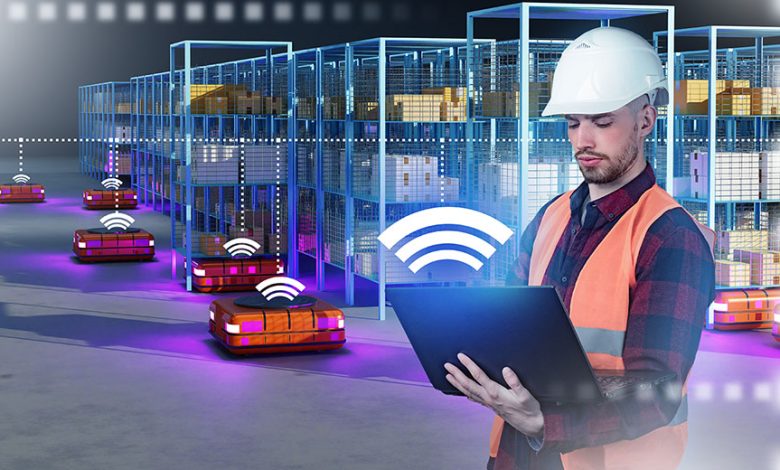
As fleets of self-driving robots increase in warehouses and stores, the robots-as-a-service (RaaS) business is expected to rise by more than 30% every year until 2030. This will create a need for more dependable wireless connections than regular Wi-Fi can give.
In January, private 5G networking company Celona and connectivity provider Digi International started providing the next generation of RaaS on a large scale to major retail operations. They recently talked about their new technology at the National Retail Federation (NRF) as a one-of-a-kind, private 5G connection system that keeps robots online, which keeps safety high and stops them from accidently destroying stuff.
Digi and Celona worked together to connect Digi’s industrial edge devices and gateways to Celona’s private 5G LAN infrastructure. That means that Digi-certified technology, such tough routers and IoT gateways, works right out of the box to make warehouse operations more reliable where regular Wi-Fi doesn’t work well.
Computer vision, autonomous robots, and connected workers all need wireless networks that are fast and have a lot of capacity to keep track of inventory. Digi’s industrial routers and edge devices connect older equipment like programmable logic controllers (PLCs), sensors, and private networks. This makes it easy to set up and grow automated systems in stores.
Mehmet Yavuz, co-founder and CTO of Celona, said that safe, high-performing retail settings need to have consistent connectivity.
“We found out that a lot of the robots, or autonomous mobile robots (AMRs), don’t have the 5G module built in,” he told the E-Commerce Times.
According to Amir Bushehri, the strategic partnership director at Digi, these kinds of vehicles are ubiquitous in warehouses, distribution facilities, and factories.
“In the past, there were more automated guided vehicles (AGVs) that traveled along rods or magnetic tape. He told the E-Commerce Times, “Today’s warehouse robots are becoming more and more independent, and they need better connectivity for safety reasons.”
Why Wi-Fi Doesn’t Work for Warehouse Robots
AMRs utilize cameras, sensors, and AI to find their way around and move things across buildings without having to follow set paths, signs, or people all the time. They plan their routes on the fly to avoid obstructions, which makes them perfect for warehouses and factories that are always changing.
Bushehri said that AMRs move around by following radio signals. Operators must always know where these devices are. If the vehicles don’t signal a heartbeat and then stop working, it might be quite dangerous for the people who work on them.
“It requires a pulse. Most normal systems will shut down if you lose two heartbeats, for example. And now it’s a big thing for someone to run after that robot on the shop floor and tell them.
As robot fleets get bigger, Wi-Fi has some problems. Private 5G can give warehouse automation more dependable, lower-latency connectivity.
“It works because we aren’t moving. When you start going at 40 miles per hour and add more robots to the network, the Wi-Fi stops working. “The moment you go past two or three robots, it just fails,” he said.
Robot crashes are dangerous. Yavuz said that the robot situation can be more chaotic than a crowded freeway. The command-and-control process is also a problem.
“Every robot gets a message that says, “Okay, go to aisle X, shelf Y, fetch item Z, and take it to spot A.” “So, they always have to get the orders for what to do next,” he stated.
Yavuz also said that self-driving robots, like self-driving automobiles, use cameras and other characteristics of the vehicle to keep themselves safe. He talked about the safety issues that come up when there are 500 robots working in a warehouse.
“We have places like that, and they are traveling 30 miles per hour. These things are going along these tracks, but it’s like they’re traveling in three dimensions up to a certain height on the shelf. He warned, “Then, in that aisle, you have a lot of these things going very fast.”
Bushehri acknowledged that safety is a big topic. Collisions can happen because another robot may still be linked and working by the time a moving robot stops after missing a heartbeat signal. That risk, together with worries about people’s safety, shows how important it is to have reliable connectivity, which Wi-Fi doesn’t always give you.
RaaS is a new industry that has come up.
The RaaS approach was developed to make it easy for consumers to link robots to Digi gear and Celona’s private 5G network. The collaboration makes it easier to integrate and lessens deployment worries for those in the retail industry.
Yavuz remarked, “We worked with the robotic manufacturers so the customer didn’t have to find a solution on their own.” “The manufacturers don’t know enough about private 5G at this point.” That’s why we made it a service you pay for.
Bushehri thinks RaaS is one of a kind. He stated he doesn’t know of any competitors who have found an issue in the sector and offered a full solution.
“Our competitors sell parts of it, which is similar to what we were doing with end users at first.” Bushehri stated, “I’ve never seen anyone come together with a full plug-and-play solution that is fully supported and takes the work from the robotic manufacturers.”
They have teamed up on the cloud platform they name Celona 5G LAN.
Private 5G vs. Wi-Fi: The Cost
Yavuz acknowledged that a lot of retail warehouse owners see RaaS as a better option than Wi-Fi. Customers sometimes sign up for the cloud service to go along with a robotic network that uses Wi-Fi.
“But in this scenario, in a warehouse, the customers have two choices. He said they could either use 100 Wi-Fi radios or five to ten 5G radios to control their robots.
Bushehri also said that the service’s price fits with the OPEX (operating expenditure) business model, which means that a company concentrates on its continuous, day-to-day operating expenditures instead of putting a lot of money into the business up front.
“It’s a monthly fee instead of paying $1,000 for each of the 10 robots. The cost includes centralized visibility, telemetry, and a solution that is fully supported. He said, “It’s a managed service on our end.”